


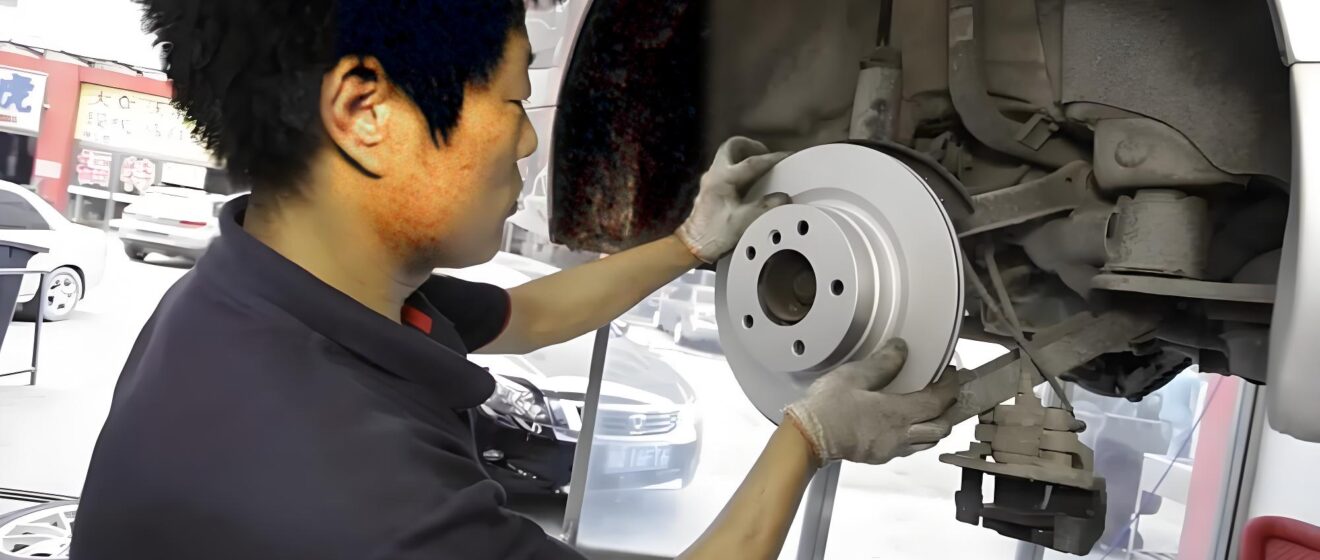
When do you need to replace your car’s brake pads?
When do brake pads need to be replaced: Check the thickness. A new brake pad is generally about 1.5 cm thick, and its thickness gradually decreases due to friction during use. Professional technicians recommend that when the brake pad thickness is only about 1/3 of its original thickness (about 0.5 cm), the owner should increase the frequency of self-inspection and be prepared to replace them. Of course, some models, due to the design of the wheel hub, do not allow for visual inspection and require removing the tires.
Each brake pad has a raised mark on both sides. The thickness of this mark is about two or three millimeters, which is the minimum thickness limit for brake disc replacement. If the brake pad thickness is already parallel to this mark, it must be replaced. Therefore, when the brake pad thickness approaches this mark, the owner should observe and prepare for replacement. However, it is difficult to accurately observe this with the naked eye without removing the tires. Currently, many models have an indicator light on the instrument panel for the handbrake when the brake pads are too thin, making self-inspection easier.
1. Small suggestion: There is no strict replacement interval for brake pads, depending on the driving environment and driving habits. Generally, replacement should be considered after about 60,000 kilometers. When you visually observe that the brake pads are thin, you should ask a technician to check them during maintenance, because visual inspection can be inaccurate. A professional repair shop using calipers is more precise than visual inspection.
Listen for sounds: If there is a “metal-on-metal” scraping sound when lightly applying the brakes, the brake pads must be replaced immediately. This is because the limit marks on both sides of the brake pads are directly rubbing against the brake disc, indicating that the brake pads have exceeded their limit. In this case, the brake disc should also be inspected when replacing the brake pads. When this sound occurs, the brake disc is often already damaged (as shown in the figure below). At this time, even replacing the new brake pads will not eliminate the noise, and in severe cases, the brake disc needs to be replaced.
2. Small suggestion: When you hear a sound from the brakes, it is often too late, and the brake disc will be damaged to some extent. The price of brake discs is much higher than that of brake pads, so it is recommended to frequently check the brake pads to avoid damaging the brake discs. When the brake pads become thinner, the braking effect will be affected. At this point, you need to press the brake pedal harder to achieve the same braking effect that was previously achieved with a light press. The braking effect in the initial stage is significantly weakened, and many people feel that their brakes have become soft and somewhat ineffective. At this point, you should check whether the brake pads need to be replaced.
3. Small suggestion: This method is relatively abstract, and it may be difficult to grasp based on feeling alone. Therefore, developing a good self-inspection habit is very important. In addition, reduced braking effectiveness will lead to increased brake fluid consumption, so it is important to check the brake fluid level when replacing the brake pads.
Purchasing and replacement suggestions: Many friends, after their warranty expires, are accustomed to buying maintenance materials themselves and going to repair shops for maintenance. For purchasing brake pads, we still recommend buying and replacing them at a 4S shop or a reputable service center. This is because the types of brake pad products on the market, especially in auto parts markets, are diverse, and it is indeed difficult to distinguish between genuine and counterfeit products, and the prices vary greatly. Some products costing only thirty or forty yuan are simply substandard. Therefore, we advise friends who lack the ability to distinguish between genuine and counterfeit products not to be tempted by cheap prices and buy substandard products that endanger driving safety.
Genuine brake pads have exquisite packaging and are all equipped with a certificate of conformity.
Substandard products, although their packaging has brand trademarks, are poorly made and do not have a certificate of conformity.
If the brakes pull to one side: Many friends feel that their vehicles have a slight tendency to pull to one side while driving, and at this time, they often conclude that four-wheel alignment is needed. It is important to note that if the vehicle is otherwise normal while driving, but only pulls to one side when braking hard, then the braking system needs to be checked.
 Account
 Categories
 Car filter
 Search
 Top
Top